AvitoC2C Marketplace

Designing Avito's job search around first-time applicants

Platform

iOS

Role

Product Designer

Date

2019

Overview

In 2019, Avito set me a time-boxed design exercise as part of its hiring process: improve how people find work through the app. I worked solo — every decision on this page is mine.

Avito led the job-search category in Russia, but I chose not to design for everyone. I bet the concept on one group: people applying for a job for the first time. The exercise advanced me through the interview process without ending in an offer — and the decision the panel pushed back on hardest is the one this page is about.

Problem

Entry-level listings all look the same — similar pay, similar requirements, nothing to tell them apart. The jobs behind them lead to very different careers, and the people choosing have the least experience to choose with.

Started too broad: my first pass was a general job-search redesign. It had no edge, so I threw it away and narrowed to the wedge where the product could matter most — 18-to-25-year-olds after a first job. That segment was my bet, not a research finding; the exercise had no field research in it.

In 2019, blue-collar hiring in this market still ran offline — phone calls, word of mouth, printed notices. The app had to win people who were not looking online at all. To find where momentum died, I mapped the journey myself — my own analysis, with no fieldwork behind it:
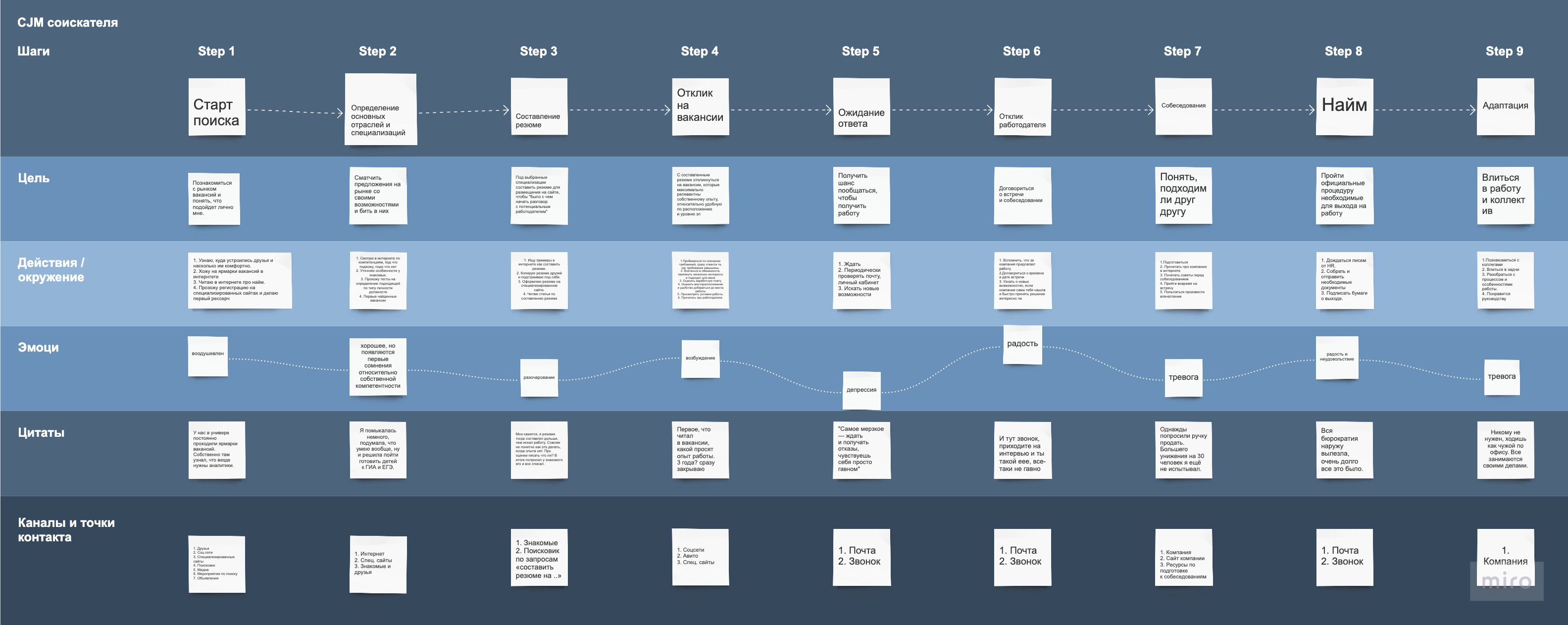
Customer journey map of a first-time applicant, from deciding to work to accepting an offer

A friend's CV beats a blank template

The concept starts where a first application starts: with a CV that does not exist yet.

Rejected: a template library. Templates are the standard answer, and they fail exactly this group — a template is abstract, and someone who has never written a CV does not know what belongs in the blanks. What that person does have is a contact list full of peers in the same situation. So the concept lets an applicant copy a friend's CV and edit it into their own: a real example instead of an empty form.

The prototype turns the cold start into an edit — a working draft exists seconds after picking a friend:

The point of copying is confidence: the applicant starts from something that already looks plausible.

Employer reviews — the bet the panel called naive

Before applying, an applicant has to judge the employer with almost nothing to go on. Reviews from people who had interviewed or worked there would answer that directly.

Rejected: protecting the paying side. Employers are Avito's paying customers, and the safe version of this concept leaves them unrated. I argued for shipping reviews anyway: evaluating employers was where applicants' effort went, and review signal was the direct fix.

The resulting screen puts the judgment where the effort was going — review signal on the vacancy itself:

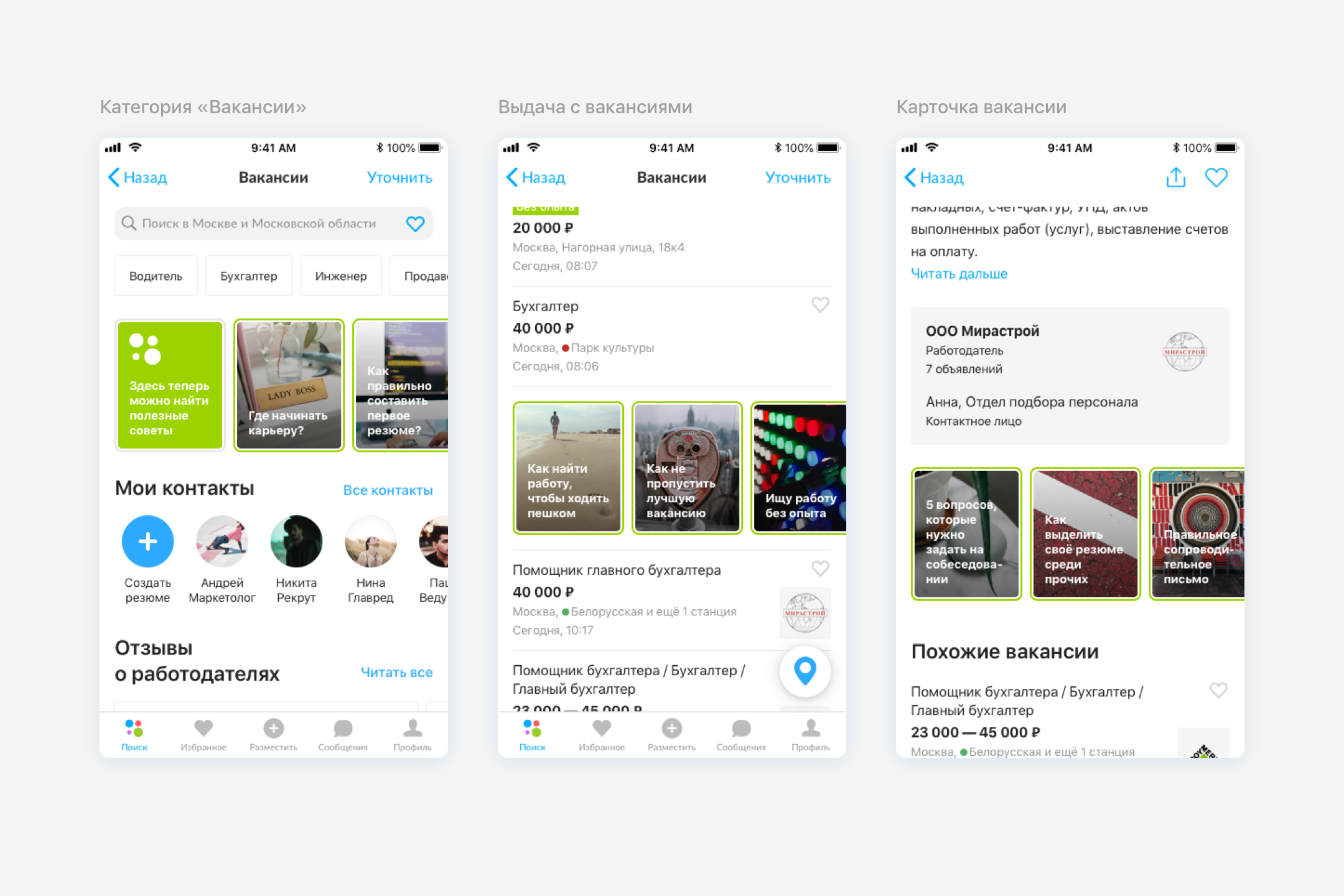
Contacts and employer reviews sit on the jobs category screen itself, above and below the listings:

Three screens: category view with contacts and employer reviews, listings, and a vacancy card

Around the two big calls sat quieter scaffolding: contextual tips staged along the funnel, expected employer response times, and saved searches. In the prototype, the tips stay inside the funnel — help appears at the step it belongs to, not in a separate section:

The vacancy card shows the employer's typical time-to-hire next to the contact buttons:

And the feed learns what the applicant is after, so the daily list stops being the same undifferentiated wall:

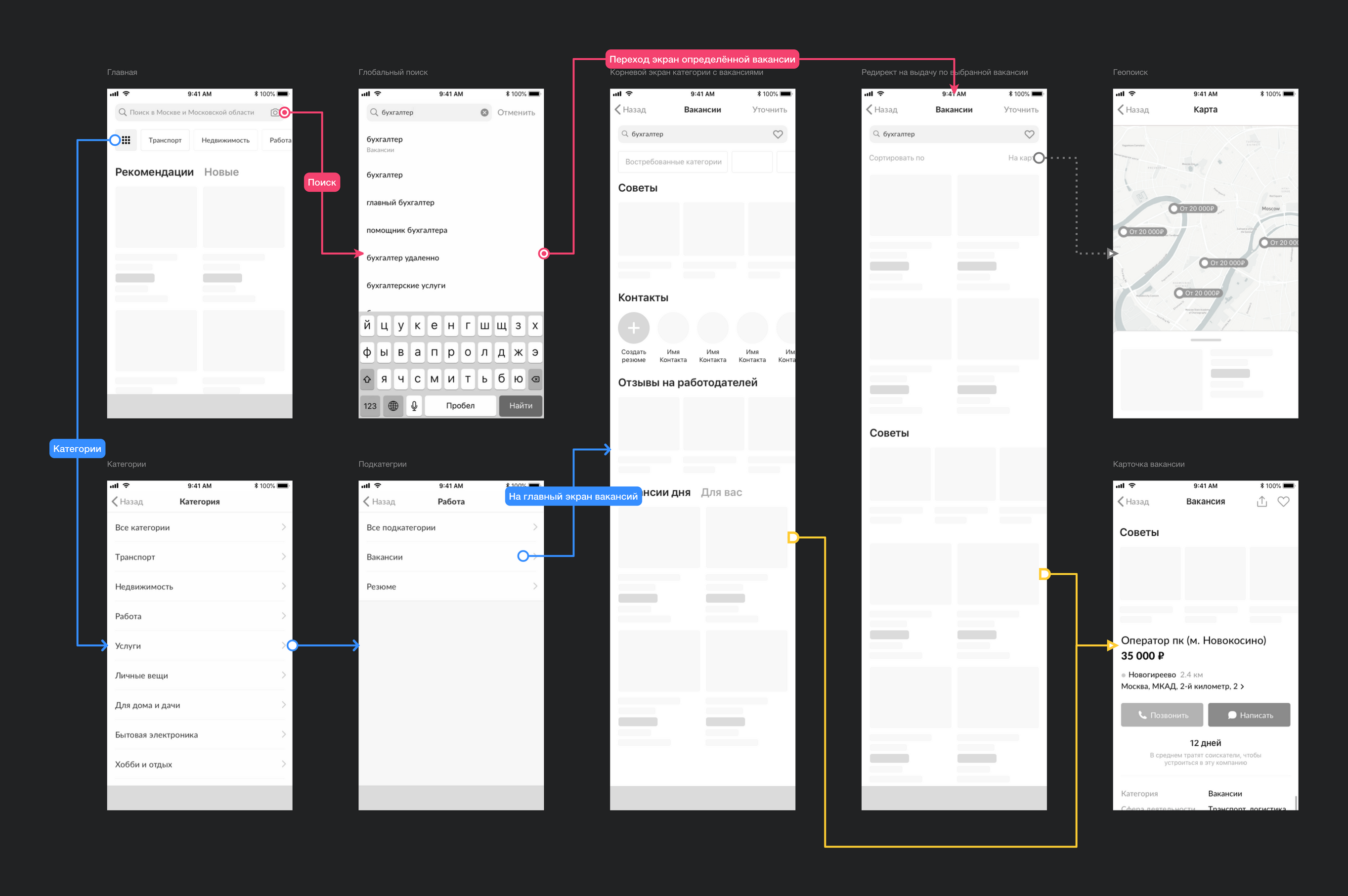
The wireframe flow is where those pieces were sequenced — search, category, listing, vacancy, and the tips and reviews hanging off them:

Annotated wireframe flow linking search, category, listing and vacancy screensOpen full size

Outcome

Advanced through the panel, no offer. Nothing here was built — it was an interview exercise, and it makes no claim on anything Avito shipped afterwards.

The sharpest feedback landed exactly where I had taken the risk: the panel called employer reviews commercially naive. The decision, the pushback, and the outcome are one story — I took a risk on the applicants' side of a two-sided market, and the panel priced that risk differently.

Trade-off: the wedge excludes the experienced. Optimizing the funnel for 18-to-25 first-timers leaves experienced blue-collar workers with a worse experience.